Posts mit dem Label 1800 Batist Kleid werden angezeigt. Alle Posts anzeigen

Montag, 27. April 2015

1800, Feierkleid Athénien

Wie schon im vergangenen Beitrag erwähnt, weilte ich kürzlich auf einem Ball im wunderschönen Helvetien. Die erste Frage, die mich ob der Einladung traf, war  - und das war damals sicherlich nicht anders:
"Was ziehe ich nur an?!"
Glücklicherweise lieferte mir das Journal des Luxus und der Moden eine Antwort, denn im Jahre 1800 herrschte allerorts eine elegante Schlichtheit und diese wurde in den Journalen hochgelobt.
Nun muß ich gestehen, dass ich eher der apollonischen Muse Kalliope zugetan bin, denn der entzückenden Terpsichore, also benötigte ich nicht vorrangig ein Tanzkleid, sondern war mit einem Feierkleid bestens ausgestattet.
Und es mußte nichteinmal neuer Stoff geordert werden, denn ich hatte ein weißes Kleid bereits in meinem Schrank und mit den nötigen Veränderungen würde es der neugriechischen Schlichtheit mehr als gerecht werden.
Das Material ist ein feiner Batist, der allerdings ähnlich wie ein Seidencrepe gewebt ist. Dazu kam noch ein sehr feiner Mousseline.
Like I've already mentioned in my previous post, I've spent a weekend at a ball in beautiful Helvetia. My first thought upon the invitaion was - and I suppose nothing has changed much about this during history:
"What shall I wear?!"
Luckily the Journal des Luxus und der Moden helped me in my choices, because in the year 1800 it was all about elegant simplicity, which was highly praised in all journals.
Now I have to admit, that I'm biased by the muse Calliope rather more than by the lovely Terpsichore, which means I needed more of an evening dress than a dancing gown..
And I did not even bothered to purchase new fabric, because I already have a beautiful white dress in my wardrobe and with some necessary alterations it would truly praise the greek simplicity.
The dress was made of an amazing batiste, which was woven like silk crepe. I also needed less than a yardage of fine muslin.

Zunächst galt es, die langen Ärmel herauszutrennen. Bei Bedarf können sie jederzeit wieder eingesetzt werden.
First I carefully unpicked the stitches of the long sleeves. These can be added again whenever I feel the need for it.

Am Rocksaum wurde aus dem Mousseline eine Kante en falbala angesetzt. Ich bitte, die Falten zu entschuldigen, die Repasseuse war noch nicht tätig.
The skirt's hem was adorned with an edge en falbala. Please excuse the creases, the repasseuse hasn't done her duty yet.
Das Kleid mit den neuen Ärmeln aus Mousseline.
The dress with the new muslin sleeves.

Die Rückansicht.
The back.

Der neue Mousselineärmel besteht aus zwei Teilen, wobei der untere Abschnitt stärker gerafft ist.
Durch das Batistband wird die Nahtstelle verdeckt.
The new muslin sleeve is made of two parts, where the lower part is much more pleated.
The batiste band covers the seam.

Ein Tageskleid wird zum Feierkleid.
A day dress turns into an evening dress.

Der neue Ärmel wurde mit einfachen Rückstichen eingesetzt.
The new sleeve was set in with back stitches.

Die angesetzte Falbala wurde entlang des Saums rolliert und aufgenäht.
The muslin falbala has a rolled hem and is simply stitchted onto the hem.

Der einzige Hingucker bei dem weißen Kleid ist ein schmaler hellblauer Seidengürtel mit einer Silberschnalle.
The eyecandy of this dress is a smal light blue silk belt with a silver clasp.
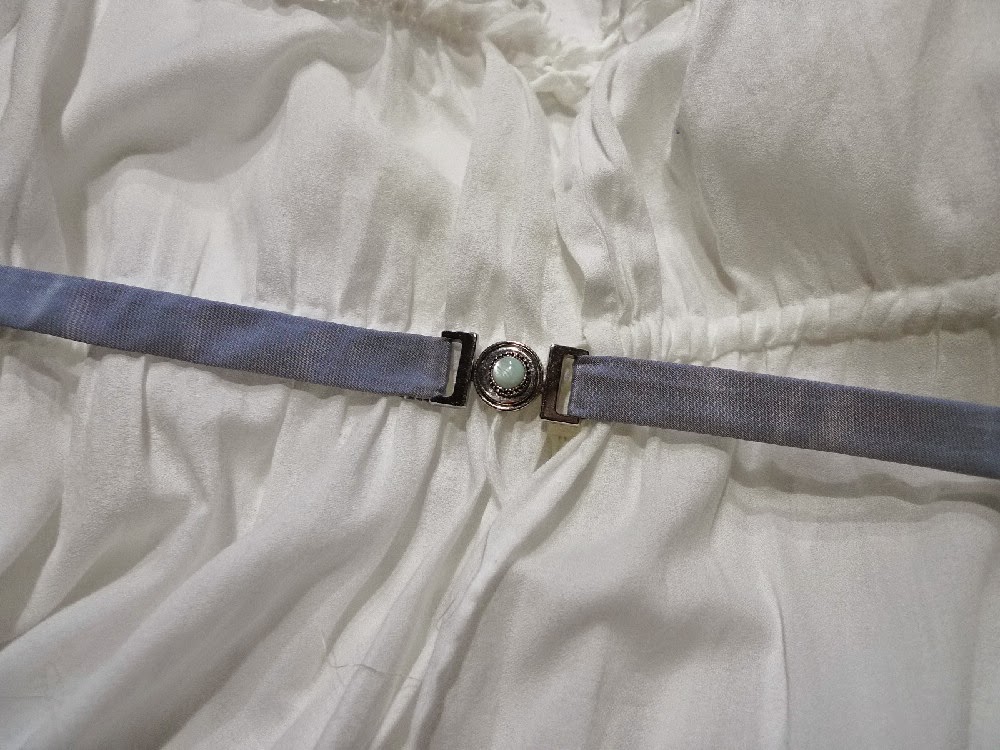
Das Kleid erfüllt wirklich alle Ansprüche an die damalige Anlehnung an das Altertum.
The dress fulfills all period demands of the appearance of antiquity.

Die entzückende Mme Reeves und ich auf dem Ball.
The adorable Mme Reeves and me at the Ball.
(Fotorechte/photo copyright: S.Gaus empirepicknick.ch)

Zu einem Kleid im athenischen Stil gehört selbstverständlich auch die passende Frisur und auch hier lässt uns das Journal des Luxus und der Moden nicht im Stich.
This dress in the athenian style requires a matching hair do, which is also described in the Journal des Luxus und der Moden.
April 1800, Journal des Luxus und der Moden, Modenbericht
(Quelle/source: thulb Uni Jena)

Translation:
This new hairdo requires three main aspects. Most attention has to be paid to the curls on the forehead, the temples and the ears, which should occur in artistic derangement (les meches pendantes).
Next are the braids coming from the tail (les nattes), which have to run in plenty labyrinths back up to said tail.
In between bands of satin or silk crepe, artificial flowers or roman tiaras of gold, but never a feather or some esprit. This would be a fauxpas and called Vieillerie.

Meine athenische Frisur. Im Hintergrund Mme vom Stein mit einer herrlichen römischen Flora Frisur.
My athenian hair do. In the background Mme vom Stein sports an enchanting roman Flora hair do.
(Fotorechte/photo copyright: Eliane Caramanna)


Montag, 9. April 2012

1800s MET Spencer (Jacket)

Nicht nur der Blog hat einen kleinen Frühjahrsputz erfahren, auch die andere Bedeutung des Wortes "Putz" ist zum Tragen gekommen: 
meine Interpretation des Spencers aus der Sammlung des Metropolitan Museum of Arts (NY) putzt ungemein.
The german language offers a term that not only covers the meaning of "cleanup", but also describes the old fashioned word for "finery". 
According to this word with double meaning, not only my blog has gone through a minor spring clean, but I have also finished my interpretation of the spencer jacket from the Metropolitan Musuem of Arts (NY).

Statt einen feinen Seidenstoff wie beim Original zu verwenden, habe ich einen bedruckten Baumwollstoff in Ocker ausgewählt. Ich habe etwa 2 Meter bei einer Stoffbreite von 1.12 m benötigt. Der frühe Spencer ist komplett
mit hellem Baumwolltuch gefüttert und von Hand genäht.
Bei dem Originalstück sind nur die Knopflöcher zu sehen, Knöpfe scheinen nicht mehr vorhanden, daher habe ich mich für Holzknöpfe entschieden, die mit dem eigentlich Stoff überzogen wurden.
Instead of the silk, which was used for the original piece, I've chosen a printed cotton in ocher. I needed about 2.1 yard with a fabric widths of 44 inch. This early spencer is completly lined with white cotton and it's entirely hand sewn.
Shown on the original piece are five buttonholes, but no buttons. I decided on wooden molds covered with self fabric.

  Deutlich zu erkennen sind die drei Nahtlinien des Punktstichs, mittels welchem ich den gerüschten Kragen aufgenäht habe.
The inside reveals the three lines of the pointstitches, which have been used to fastened the ruched collar.


Bei dem Original sind keinerlei zierende Steppnähte sichtbar, zudem besteht das Rückenteil aus zwei Hälften.
Gut erkennbar ist der ausgestellte Ziersaum des Spencers, der bei späteren Spencern durch ein richtiges Schößchen abgelöst wurde.
There's no evidence of decorative topstitching on the original, and the back part is made of two pieces.
Another hallmark of the early spencer is the belt, which leads to a decorative embellishment in the back, while in later spencer it's gradually replaced by true peplums.

Die Ärmel bestehen jeweils aus zwei Teilen. An den Aufschlägen wurde eine gerüschte Verzierung aufgenäht. Der Saum der Rüsche ist mit einfachen Überwendlichstichen versäubert.
The sleeves are made from two pieces each. The cuffs have a ruffled finish sewn onto. The seam of the ruffle is finished with overcast stitches.

Zu dem Spencer trage ich ein frühes Batistkleid mit passendem Unterrock, ein Unterhemd, Kurzkorsett, ein Fichu/Schultertuch sowie passendes Schuhwerk.
I'm wearing an early dress made of fine cotton batiste with a matching petticoat, a shirt, short stays, a fichu/kerchief and matching footwear.

Der Kragen ist etwa 9 cm breit und in drei Reihen aufgenäht. Wie beim Original folgt er keiner ordentlichen Faltenlegung, sondern wurde einfach gerüscht und vernäht.
The collar measures 3.54 inch and is stitched onto with three rows. According to the original the collar doesn't follow a neat pleating, but is simply ruffled and sewn on top.

 Die Rückenansicht mit den weit in den Rücken ragenden Ärmelausschnitten.
The back view showing the large armholes, which create a narrow back.

Die Anfertigung des Spencers war ein reines Vergnügen und ich denke, das wird nicht der letzte frühe Spencer auf meinem Nähtisch gewesen sein. Vielleicht folgt irgendwann noch ein Exemplar aus Seide...und noch ein anderes frühes Kleid dazu...und...und...und...
This spencer jacket was truly fun and I think this wasn't the last one I've sewn. Maybe there will be another one made of silk...and another matching early dress...and...and...and...

Mittwoch, 18. Mai 2011

Gut behütet im Garten

Nach ein paar kühlen Regentagen und dem unvermeidlichen Schnupfen, lockte der vielversprechend sonnige Tag heute wieder in den Garten.
Und was passt besser bei Sonnenschein als ein neuer Strohhut?
After a few rainy days and the inevitable cold, it was a promising and sunny day today, thus I went for a stroll in the garden.
And what is more appropriate for a walk in the sunshine than a straw hat?
Der Strohhut ähnelt eher einer Schute. Ich habe ihn aus einem alten Strohhut mit flachem Rand und runder, konvexer Krone gefertigt. Zunächst hat er ein Bad in lauwarmem Wasser genommen, bevor ich ihn über einem Stumpen in Form gebracht habe. 
The straw hat resembles a bonnet. I've made it from an old straw hat with flat brim and a round, convex crown. First I soaked it in lukewarm water, before I pressed it over a cylindrical form to get a small flat crown and a shaped brim.

Meine Inspiration war eine Mischung der Strohhüte der Modelle Francoise und Emma aus dem Buch "Napoleon and the Empire of Fashion", sowie der folgende Modekupfer.
My source of inspiration has been a mix of the strawhats of the models Francoise and Emma from the book "Napoleon and the empire of fashion", and the following fashion plate.

Um die Schute zu befestigen benötigt man nur ein ausgedientes Fichu, das mit großer Schleife unter dem Kinn geknotet wird. Und schon geht's zum Flanieren!
To fasten the bonnet you'll only need a fichu, which is tied with a fluffy fluff under the chin. And then it's off to take a stroll!


Freitag, 11. Februar 2011

K(l)eine Geheimnisse

Einige Detailaufnahmen vom Oberteil des 1800 Batistkleides.
Some detailed pictures of the 1800 batiste dress.
Das Innenleben mit den "Flügeln". Ich verwende am liebsten Stecknadeln zum Schließen.
The lining with the "wings". I prefer pins to close it.

Der Tunnelzug des Oberstoffes mitsamt Bändern
The frontcasings with the drawstrings

Die Rückseite
The back


Sonntag, 6. Februar 2011

Frühling, Sonnenschein und Picknick...

...klingt doch irgendwie vielversprechend im Februar.
Nach dem detailreichen KCI Kleid stand mir der Sinn mal wieder nach etwas schlichterem. Heraus kam ein langärmliges Frühlingskleid aus feinem weißen Crepebatist. An den Ärmeln und dem Kragen sind klitzekleine Rüschen. Das Kleid wird vorne durch einen Tunnelzug geschlossen.
Das Oberteil ist mit Batist gefüttert, die Ärmel und das Rockteil sind ungefüttert.
Nun fehlt nur noch der Sonnenschein...
Spring, sunshine and picnic...sounds promising in February, doesn't it?
After the excessivly decorated KCI dress I wanted to sew something simlpler.
I ended up with a longsleeved, springlike white dress made of fine crepe batiste.
I added tiny ruffles at the cuffs and the collar. The dress is a front closing gown with drawstrings. The bodice is lined with batist, the sleeves and the skirt are unlined.
Now I'm desperately waiting for sunshine.


...und zuletzt ein Bild mit meiner "neuen" historischen Brille, dem hellblauen Spencer und dem Strohhut, den ich mit einem grünweißen Karobaumwollstoff gefüttert habe.
...and finally a picture of my new period glasses, my babyblue spencer and the straw bonnet, which I have lined with green/whicht check cotton.

Samstag, 5. Februar 2011

Puzzle

Ein Puzzle, dem nur schwer zu widerstehen ist.
A puzzle, which is hard to resist.
Der Zuschnitt von meinem neuen Tageskleid aus frühlingshaftem Feinbatist. Diesmal sehr frühes 19. Jahrhundert (oder sehr spätes 18. Jahrhundert). Das Kleid ist mittlerweile genäht...morgen hoffentlich - bildlich gesprochen - mehr.
The pieces to my latest day dress made of fine batiste. This time very early 19th century (or very late 18th century). The sewing is done so far...hopefully I'll have some photos to share tomorrow.