Montag, 25. Juni 2012

Es wird bunt!

Statt Sommerfrische, nichts als Regen, grauer Himmel und trostlose Gemüsebeete!
In dem trüben Einerlei sehnt man sich förmlich nach ein wenig Farbe, also habe ich mich zu einem Wechsel bei meinen Projekten entschlossen. Statt die Planung von Guillaume Guillon-Lethières "Portfolio Girl Kleid" fortzusetzen, 
ist nun erstmal der wunderschöne Spencer aus maigrüner und bonbonrosafarbener Seide auf meinem Nähtisch gelandet.
Was für ein willkommener Augenschmaus!
Instead of summer's sunshine, we suffer from rain galore, grey skies and dreary vegetable beds!
In this weary bleakness everything calls for some colour at least and this is why I changed my mind regarding the projects. I've put the Guillaume Guillon-Lethières "Portfolio Girl Dress" on hold, while a lovely spencer in beautiful spring green and candypink silk found it's way on my sewing table.
What a delight to the eye!

Seidenspencer, frühes 19tes Jahrhundert (Quelle: met Museum)
Silk spencer, early 19th century (Source: met Museum)

Einen passenden Stoff aus Seidentaft habe ich leider nicht gefunden, aber einen feinen Baumwollwebstoff aus der Robert Kaufman Serie. Sogar nach dem Waschen behält der schöne Stoff einen gewissen Stand...und die Farbe: die ist wunderbar!!!
I didn't manage to find a suitable silk fabric, but I've chosen a fine cotton fabric. Even after the first wash it has kept it's stand...and the colour:
it's wunderbar!!!

Sobald der Regen sich endlich erbarmt, werde ich auch einen ausführlichen Bericht (mit reichlich Fotomaterial belegt) über das blaue schlichte Leinenkleid und den ockerfarbenen "Graenicher" Spencer 1806 der Dresdner Köchin nachliefern. 
Einen kleinen Vorgeschmack gibt es aber bereits an dieser Stelle:
As soon as the rain finally shows some mercy, I'll post in detail (and with plenty of photos) about the blue linen dress and the ochre-coloured "Graenicher" spencer 1806 of the Dresdner female cook.
But here's already a first sneak peek:

Montag, 11. Juni 2012

Graenicher, Lethière und Boilly

Doch...doch, die Arbeit an meinem Leinenkleid geht unvermittelt weiter. Inzwischen ist auch die Schürze fertig und nun geht es an die schlichte Spencerjacke aus ockerfarbenem Leinen. 
Als Inspiration dafür (und überhaupt für das Ensemble insgesamt) diente mir die Köchin aus Samuel Graenichers (1758-1813) Feder.
Entstanden ist das Bild etwa um 1806 und wenn man sich im Netz weiter umschaut, entdeckt man auch eine farbige Abbildung in eben jenem Ockerton, der schon so lange als Leinenstoff in meinem Schrank schlummert.
Oh well...well, there's still much progress on my blue linen dress. Meanwhile I've finished the apron and now I'll start with a matching linen spencer jacket in an ocre colour.
The inspiration for the jacket (and the whole ensemble) is loosely based on a drawing from Samuel Graenicher (1758-1813) of a female cook.
The drawing is dated from 1806 and further search of the web reveals that there's a coloured plate with exactly the same shade of ochre than the linen, which lie dormant in my fabric stash for a long time.
Graenicher, Dresdener Köchin 1806

Und da ich mittlerweile großen Gefallen an der Jahrhundertwende gefunden habe, ist es an der Zeit demnächst ein Ensemble zu verwirklichen, dass mir schon lange Zeit am Herzen liegt.
Es handelt sich um Guillaume Guillon-Lethières (1760-1832) Bild "Girl with Portfolio" von 1799.
Das Bild bzw die dargestellte junge Frau hat eine unglaubliche Ausstrahlung und nimmt einen vom ersten Augenblick für sich ein. Ihre Kleidung ist schlicht, aber überaus stimmig und ich freue mich schon sehr auf den Versuch Kleid und Spencer Leben einzuhauchen.
As I'm actually hooked by the turn of the century, it's about to create an ensemble, which I already fell in love with some time ago.
It's Guillaume Guillon-Lethière's (1760-1832) painting "Girl with portfolio" from 1799.
The girl in the painting looks fascinating and easily catches the viewer's attention. Her clothing is simple and sober and yet very beautiful. I'm truly looking forward to recreate the garments.

Zudem lockt mich dieses Projekt, weil ich bei der Verwirklichung des Kleids ziemlich freie Hand habe, da man im Gemälde nur einen Blick auf den Rock erhascht. Zu diesem Zwecke studiere ich gerade - zu meinem großen Vergnügen - unzählige Bilder, allen voran die von Louis-Léopold Boilly (1761-1845).
This project is also very appealing as I can choose the shape of the bodice of the dress to my own liking, the painting only shows the skirt. For this reason I'm currently studying - with great pleasure - plenty of period paintings and especially those of  Louis-Léopold Boilly (1761-1845).

Donnerstag, 7. Juni 2012

...dann mach ich mir 'nen Schlitz ins Kleid...oder auch zwei!

Die Näharbeiten am blauen Leinenkleid habe ich bereits vor einigen Tagen abgeschlossen, aber aus unerfindlichen Gründen spielt das Wetter nicht mit - immerhin das Kleid ist für den Garten angedacht und nicht für Arbeiten im Eishaus!
In der Zwischenzeit war ich nicht untätig, sondern habe mich an die Accessoires begeben, denn was ist schon ein Leinenkleid für die Gartenarbeit, wenn es keinerlei Taschen hat!
Taschen?!
Allerdings! Während ich mich eifrig durch die Bücher "What clothes reveal" von Linda Baumgarten und "Costume in detail" von Nancy Bradfield blätterte, entdeckte ich nicht nur einen Hinweis für Schlitze im Rockteil eines Kleides von etwa 1806, sondern auch Taschen, die nicht mit Stickereien - wie im 18ten Jahrhundert üblich - verziert waren, sondern aus Reststücken zusammengeflickt waren.
Beide Funde fügten sich wunderbar zu dem Arbeitskleid!
I've already finished sewing on the linen working dress several days ago, but unfortunately the weather is less than fine for the past few days - alas, the dress is intended for garden work and not for working in an ice house!
Meanwhile I've been busy to sew accessories, because a dress for garden work should have pockets!
Pockets?!
Well, sure! While busily studying "What clothes reveal" by Linda Baumgarten and "Costume in detail" by Nancy Bradfield, I not only found evidence for pocket slits in an 1806 muslin dress, but also pocktes made from fabric scraps, instead of the well-known embroidered and eleborate 18th century pocktes.
Both finds made perfect sense for building up a working garment wardrobe!
Der Rock des Kleides besteht aus zwei Teilen, die unterhalb der Verbindungsnaht von Rock und Oberteil auf beiden Seiten auf die Länge von etwa 20 cm geöffnet werden. Dahinter erkennt man die Tasche, welche mit Bändern um die Hüfte getragen wird.
The skirt is made of two large pieces, which are opened quite close to the raised waistline on both sides. The slit is about 20 cm. Behind the slit is the pocket, which is worn with a linen belt round the waist.

Und das ist die Vorlage aus "Costume in detail".
This was the inspiration from the book "Costume in detail".

Nachdem ich in dem Buch von Linda Baumgarten den Hinweis auf eine Patchworktasche entdeckt hatte, begab ich mich im Netz auf die weitere Suche nach Fundstücken...ich habe noch einige Exemplare aufgetan, aber im Gegensatz zu den feinen, gestickten Taschen sind leider nicht allzuviele Stücke erhalten, was daran liegen mag, dass die Kleidung der "arbeitenden Bevölkerung" eher dem Verschleiß anheimfiel.
After getting a hint to pockets made from fabric pieces, I tried to gather further proof in the width of the web...I made a few more finds, but unlike the fine embroidered pockets of the 18th centuries, the pockets made from fabric scraps are unfortunately quite rare, due to the fact that garments from the "working class" usually have been made to wear & tear.

frühes 19. Jahrhundert Tasche/ early 19th century Bag (Pocket) Met Museum NY

Dank Mme du Jard hatte mich zu jenem Zeitpunkt gerade das English Paper Piecing Quilten gepackt, also wagte ich mich mit dieser Technik gleich mal an eine Tasche, obwohl zeitgenössische Stücke tatsächlich eher aus quadratischen Stoffstücken bestanden...
Mme du Jard most recently introduced me to the highly addictive English Paper piecing quilting, thus I decided to try this technique at least on one of the pockets, although most extant pockets were usually made of square fabric scraps...
Die Taschen bestehen aus bunten Baumwollreststücken bzw ungefärbter Baumwolle (Rückseite). Sie messen etwa 20cm x 40cm. Das Schrägband ist ebenfalls aus Resten gefertigt. Vernäht wurde alles per Hand mit Leinenfaden. Die beiden Taschen sind mit einem groben Leinenband verbunden.
The pockets are made from colourful cotton fabric scraps and unbleached cotton (backside). The measurements are approx. 20cm x 40cm. The edges are bound with scraps, cut on the bias. The entire piece is handsewn with linen thread. Both pockets are connected with linen waistband.
Die Rückseite
Back view
Zur Zeit arbeite ich noch an weiteren Details für ein komplettes Ensemble, wie z.B. einer Leinenschürze und einer schlichten Spencerjacke aus grobem Leinen...und natürlich warte ich auf besseres Wetter...
I currently work on further additions like a linen apron and a plain linen spencer jacket to complete the "working" dress look...and I do wait for the weather to improve...

 Ein kleiner, aber nicht unbedeutender  Nachtrag: Wie es der Zufall so will, beschäftigt sich Lauren auf American Duchess derzeit mit bestickten Taschen und sie hat diesbezüglich eine hervorragende Quelle aufgetan...hier entlang, bitte: Patchworktaschen!
 A short, but interesting supplement: As it happened Lauren over at American Duchess currently discusses about embroidered pockets and she provided us with an excellent link, please follow here: 
patchwork pockets!

Donnerstag, 24. Mai 2012

Die Ballade vom trotzigen Leinenkleid

Was als schnelles Nähstück für zwischendurch angedacht war, entpuppte sich als langwierige Angelegenheit und mahnende Lektion. Ich weiß nicht, ob es einem Übermaß an Sonnenschein, Sauerstoff und Vogelgezwitscher (denn natürlich steht außer Frage, dass bei diesem Wetter im Freien genäht wird), zuzuschreiben ist, aber das schlichte Leinenkleid um 1800 stellte mich von Beginn an vor Herausforderungen...
...möglicherweise lag es auch daran, dass ich keine genauen Vorstellungen hatte, wohin die Reise gehen sollte. Fest stand nur, es sollte ein bequemes Kleid sein, das für die Gartenarbeit taugt und Züge des frühen 19.Jahrhunderts trägt.
What I inteded to be a quick'n'easy project, proofed to be a tedious work and a good lesson for me. I wonder, wether it's due to the overabundance of sun, oxygen and bird song (of course having the most beautiful weather outside, I do sew in the garden), but the linen dress was a challenge right from the beginning...
...probably one reason might have been, that I didn't had any precise ideas how it should look like. I only knew it should become a comfortable dress for gardening and it should have the features of an early 19th century dress.

Also ran an die Schere und den Stoff, um ein paar Probestücke zu schneidern.
I fetched my scissors and some fabric to do a few mock-ups.
Das obere Stück schied schnell aus, aber der zweite Versuch mit den geteilten Nähten, die noch eine kleine Erinnerung an das 18.Jahrhundert gewährten, gefiel mir. Ja, zu einem Kleid für die tägliche Arbeit in Haus und Hof passt ein Schnitt, der den Anschein verbreitet, aus einem früheren, abgelegten Kleid zusammengeschnitten worden zu sein.
The upper piece soon lost my attention, but the second mock-up with the extra seams on the back piece, was very much to my liking, as it was a bit of a reminder of the 18th century fashion. Yes, indeed, the pattern was quite suitable for a working dress, as it gives the impression that a former dress/fashion was turned into a new dress.
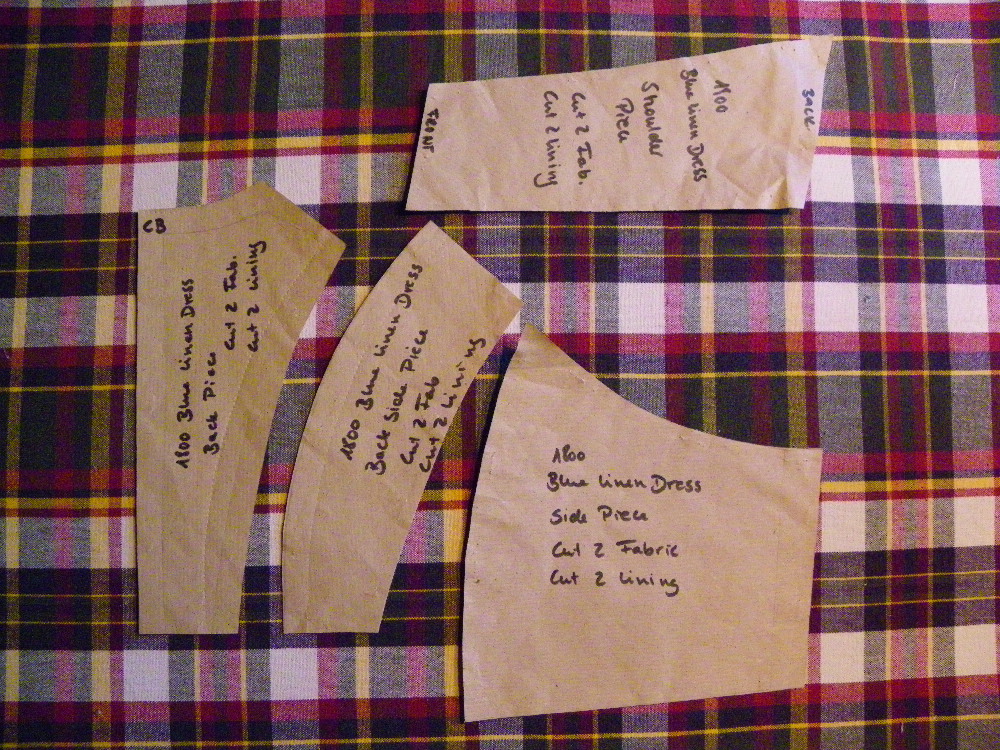
Und so sieht es dann schließlich auf dem Papier aus. Im Bild sind die Teile für den Rücken einschließlich der Träger.
And that's what it looks like as a paper pattern. These are actually the pieces for the bodice's back including the shoulder strap.

Nachdem das Oberteil zusammengenäht war, ging es zuversichtlich an die Ärmel. Ich wollte unbedingt zweiteilige Ärmel einsetzen und auf jeden Fall lange Ärmel (auch wenn man auf Bildern dieser Zeit beim "arbeitenden Volk" eher halblange Ärmel sieht). 
Und da befand ich mich wieder mitten drin in der Ballade vom trotzigen Leinenkleid. Ich habe die Versuche irgendwann nicht mehr gezählt (aber in steter Erinnerung wird mir der Versuch bleiben, als ich einen Ärmel versehentlich falsch herum eingenäht habe). Es bedurfte wohl einem halben Dutzend kläglicher Bemühungen, zweier Schnitte und vielen aufgetrennten Säumen, ehe mich das Ergebnis endlich...endlich...zufriedenstellte.
After I've had assembled the bodice, I confidently started with the sleeves. I wanted two pieced sleeves and long sleeves (although many period paintings and caricatures show working class peoples' sleeves, which only reach down to the elbow).
And there I found myself amidst in the Ballad of the defiant linen dress. I lost count on the many attempts (but I will always remember that I even sew in one sleeve backwards). It took surely half a dozen of pitiful efforts, two patterns, many ripped off seams, before the result finally...finally was successful.

Das Oberteil aus blauem Leinenstoff (der eigentlich ein wenig dunkler ist, als im Bild), gefüttert mit Baumwollstoffresten. Komplett handgenäht (einschließlich aller Fehlversuche) mit grobem Leinenfaden. Das Tunnelband ist aus ockerfarbener Wolle gewebt.
The bodice made from dark blue linen (it's actaully a darker blue than in the photo), lined with cotton scraps from the stash, completely hand-sewn (including all failed attempts) with linen thread. The ribbon for the closure is woven from ochre-coloured wool.

Ein Blick ins Innere
Inside view

Die Ärmelnaht bleibt unversäubert. Die meisten Nähte wurden mit dem Steppstich aufgenäht. Der Rand wurde übergeschlagen und angenäht.
The sleeve seams remain raw. Most of the seams are done with top stitch. The edge was fold over and under and sewn to the inside with overcast stitches.

Und die Rückenansicht mit den eingesetzten Ärmeln.
And the back with the "sleevils".

Als nächstes geht es an den Rock. Ein wenig bang ist mir nach all den Mühen nun doch ein wenig, aber ich geb mich mal als tapferes Schneiderlein frisch ans Werk...hoffentlich bis in Kürze...
Next step will be the skirt. After all the failures I feel a bit anxious, but like the valiant little tailor I won't give in...hope to present the finished dress soon...

Sonntag, 20. Mai 2012

Kurze Nachlese zum Corset de Soie (Corset Elastique) 1801

An dieser Stelle einen herzlichen Dank an meine werten Leser zu den wunderbaren Kommentaren zum Corset de Soie.
Beim Durchstöbern der schier endlosen virtuellen Welt, mußte ich allerdings feststellen, dass der Verschluss mit Hilfe von Schnallen bereits die Damenwelt um 1785 in Begeisterung versetzt hat.
Durch Heileen's wunderbares Pinterest Board bin ich auf dieses Portrait von George Romney (1734-1802) gestoßen.
Thank you very much to my dear readers for the lovely comments to my previous blog post about the Corset de Soie.
While roaming the sheer endless fields of the internet, I've learned that the closure on the corset wasn't actually a new invention, as fashionable women of the 1785s already fell in love with the metal buckle closure.
Thanks to Heileen's wonderful pinterest board, I stumbled upon a beautiful portrait by George Romney (1734-1802).
George Romney, A Lady in Brown 1785 (Quelle/Source wikipedia)
Das Portrait hängt in der National Gallery, London. Dort ist es unter dem Namen "Die Pfarrerstochter" bekannt. 
Unverkennbar die versetzten Schnallen und dazugehörigen Laschen, allerdings dauerte es noch einige Jahre, ehe auch das elastische Vorderteil mittels Metalspiralen Einzug in die Mode hielt!
The portrait belongs to the collection of the National Gallery, London. It's known by the name "The parson's daughter".
We clearly see the well-known shifted buckles and tongues, yet it took another decade before the "elastic" front pieces with the inserted metal springs were introduced to fashion.

Sonntag, 13. Mai 2012

1801 Corset de Soie (Corset Elastique - Corselet)

 Rechtzeitig zum sonntäglichen Sonnenschein ist das grüne Korsett aus Seide bereit um ausgeführt zu werden. Bevor ich meine werten Leser einlade, mich in den Garten zu begleiten, noch ein paar weitere Einblicke in die Konstruktion des ungewöhnlichen Keidungsstücks.
Just in time to greet Sunday's sunshine my green silk corset is done. But before I invite my dear readers to join me in the garden, I'd like to share further construction details of the unusual garment.

Das Korsett wird (wie beim Original aus der Sammlung Joconde) mittels drei Laschen aus Seide und Metallstegschnallen geschlossen.
Die Verschlüsse werden mit Rückstichen nahe am Rand angenäht und auf der Rückseite versäubert.
The corset (like the original from the Joconde Collection) is closed with three metal buckles and three silk tongues.
The closures are sewn to the front pieces with back stitches.

Der Stoff wird sorgfältig untergelegt und am Futter festgenäht. Links im Bild die seidene Lasche, die zur Hälfte mit Baumwollstoff hinterlegt ist.
The farbic is folded under and then sewn to the lining. On the left is the silk tongue, of which one half is lined with cotton.
Bei dem feinen Seidenstoff ist es notwendig, die Lasche mit Baumwollestoff zu hinterlegen, da der Stoff sonst aus der Schnalle rutschen würde. 
Ich habe aber nicht die komplette Lasche unterlegt, sondern nur einen Teil, damit man bei einem eventuellen Umklappen auf den Seidenstoff und nicht das Futter blickt.
(Nachdem ich das Korsett getragen habe, kann ich allerdings verraten, dass die Laschen keinesfalls umklappen - sie betragen sich ausgezeichnet)
As the silk is quite delicate it was necessary to line the silk to prevent it from slipping out of the buckle.
But I have only lined a part of the tongue so when it turns while wearing you won't see the lining.
(After wearing the corset I'd like to add that the tongues actually stay in place very well.)

Ein Blick auf das Futter. Von außen wird das Korsett - wie beim Original - ringsherum mit kleinen Herringbonestichen aus rosa Seidengarn verziert.
Die beiden Rückenteile habe ich übrigens mit dem doppelten Saumstich verbunden.
An inside view of the lining. On the outside the corset is - like the original - decorated with a row of herringbonestitches in blushing pink silk thread.
The back parts are sewn together with the doppelter Saumstich (doubled seamstitch).


Die Wirkung der Metallspiralen ist hervorragend, wobei sie kein bisschen unangenehm zu tragen sind.
Ein wunderbares kleines Kleidungsstück!!! Und ein seidenens Schmückstück für ein weißes Kleid!
The effect of the metal springs is amazing and they are highly comfortable to wear.
It is such a lovely little garment!!! And a silky gem for a white dress!

Und zu guter Letzt' der versproche Ausflug in den sonnigen Garten:
And now let's have a stroll through the sunny green of the garden:


Der Ausflug in die frühen 1800er hat mir dermaßen Vergnügen bereitet, dass ich mich dazu entschieden habe mit meinem nächsten Projekt noch ein wenig in der erste Dekade des Jahrhunderts zu verweilen. Beim Lustwandeln im Garten mag so ein weißes Kleid zwar angebracht sein, aber in dem Beet lauert noch einiges an Gartenarbeit und da ist ein schlichtes Leinenkleid doch eher von Nutzen...
The early 1800s are such fun that I decided to stay in the first decade of the century with my next project. While taking a stroll and having a read in the garden a white dress might be indeed very suitable, but the herb beds and vegetable beds anticipate a whole lot of work and labour, hence a linen working dress would be of great need...

Donnerstag, 10. Mai 2012

Aufgedreht!

Die Überschrift bezieht sich im Hinblick auf den Fortschritt an meinem neuen Nähprojekt, dem "1801 Corset de Soie (Corset Elastique - Corselet)", nicht nur auf meinem Gemütszustand, sondern auch auf das Geheimnis, welches sich hinter der Bezeichnung "elastisch" verbirgt!
Aber der Reihe nach...
This blogpost's title is a pun, as the German term "aufgedreht" does not only mean to be excited (coll.), it is also the word for metal being spiralled/coiled. Well, in this particular case I'm not only very excited about my current project "1801 Corset de Soie (Corset Elastique - Corselet)", but "being coiled" is also the secret behind the term "elastic"!
But first things first...

Zunächst galt es die Kanäle in das Vorderteil des Korsetts einzunähen. Bei dieser Abreit bediene ich mich häufig eines Bleistifts, um die Reihen einigermaßen gleichmäßig hinzubekommen. Die Kanäle werden mit einfachen Vorstichen genäht. Ich habe dazu eine Nadel No.12 sharp verwendet und versucht die Stiche möglichst nur etwa 1-2 mm lang werden zu lassen, da das helle Garn ja auch auf der Vorderseite sichtbar sein wird.
First I've had to sew the channels into the two frontpieces of the corset. I usually mark the rows with a fine pencil to get them at least a bit even. The channels are sewn with tiny running stitches. I've used a No.12 sharp needle and tried to get the stitches as tiny as 1-2 mm in lenght, as the off-white thread will also be seen on the silk.


Nachdem die Kanäle eingenäht sind, wird der Rand doppelt umgeschlagen und am Futter angenäht.
After the channels are sewn in, the edges of the silk will be folded under and sewn to the lining.
Hier erkennt man auch wunderbar, dass der Stoff sich bereits ein wenig fältelt.
The fabric already starts to crease.

Zeit, dem Geheimnis der eigentlich Fältelung bzw der Bezeichnung "elastisch" auf den Grund zu gehen und Material zu finden, das dem früheren entspricht.
Den entscheidenden Anstoß gab ein Korsett aus der Sammlung des met Museum NY.
Zwar ist es von der Konstruktion ein wenig anders als die drei Corsets, die meiner Reproduktion zu Grunde liegen, aber es hat ebenfalls die elastische Vorderseite...und das Corset gibt  - zu meiner großen Freude - das Geheimnis preis!
It's about time, to focus on the term "elastic" and to lift the veil, and furthermore to find a modern substitute.
The eye opener was a corset from the met museum's collection NY.
Although the overall construction of the corset is a bit different from the three examples I've chosen for my recreation, but the front also has the elastic wings...and - to my great pleasure - the secret is revealed!
Detail des Corset C.I.46.82.8 (Quelle/source Met Museum)
Es handelt sich also um eine feine Metallspirale. Bei dem Anblick gingen meine Gedanken auf Wanderschaft und tappten lange im Dunkeln, bis der Herr des Hauses mit dem entscheidenden Hinweis für Erleuchtung sorgte: 
"Das erinnert mich an die Antriebsriemen meiner Dampfmaschine"
It is a very fine metal spring. My thoughts went wandering, but I was trapped in helplessness until my dear husband made the following crucial remark:
"This reminds me of the flexible belts of my miniature steam engine"

Und siehe da, im Programm von WILESCO gibt es die Riemen in zwei verschiedenen Längen und Durchmessern - ausgezeichnet!
I'm happy to announce that WILESCO offers them in two different lenghts and two different diameters - excellent!
Wilesco Z80 Antriebsspirale 50cm Länge/2.5 mm Durchmesser
Wilesco Z80 Flexible belts 50cm lenght/2.5 mm diameter

Das Material ist wunderbar elastisch, hält aber zugleich die Form. Es ist angenehm dünn und in keinster Weise unangenehm zu tragen.
The material is gorgeously elastic, but it keeps it's shape. It's very thin and smooth to wear.

Mit einer Zange lassen sich die Stücke auf die richtige Länge bringen. Danach werden sie in jeden zweiten Kanal eingeführt und am Ende jeweils mit Stichen und Knoten verbunden.
It's easy to cut them into the required lenght. After that they are stuffed into every second channel and then stitched and knotted in place.

Der Stoff ist etwa fünf Zentimeter länger als die Spiralen, weshalb die Enden an beiden Seiten unbedingt gut verankert werden sollten. Und so sieht es aus, wenn die Spiralen fertig eingezogen sind:
The faric itself is approx. 2 inch, that's why it is essential to safely secure the ends of the spirals. And here's how it looks like when the channels are completely done:


Unglaublich elastisch :)
Incredibly elastic :)